A New Taste or Odor in California Tap Water: Nuisance or Safety Issue?
A new taste or odor at the tap can be unsettling, especially when the water looked and tasted normal before. Sometimes the change is limited to one faucet or appears after plumbing work; sometimes neighbors notice it too. The pattern can help you decide what to check, who to contact, and when a taste or smell should be treated as a possible water-quality concern.
Start by checking the pattern
A change in taste or odor does not, by itself, tell you whether water is safe or unsafe. It is a signal to investigate, not a diagnosis. Start with simple observations that help distinguish a change in the supplied water from an issue limited to your home.
Notice where and when the change occurs. Is it at one faucet or throughout the home? Does it affect cold water, hot water, or both? Is it constant, intermittent, or limited to a particular time of day? Has it changed after work on household plumbing or a utility notice? These details are useful when you contact the water supplier or another qualified professional.
If it is practical, compare cold water from more than one tap. Let the water run briefly, then notice whether the taste or odor changes. Do not treat this as a safety test: a temporary improvement, or the absence of a noticeable smell, cannot confirm water quality. If the change persists or seems unusual, record what you noticed rather than relying on memory.
| What you notice | What the pattern may help clarify | A sensible next step |
|---|---|---|
| The change appears at one faucet | Whether the issue may be associated with that fixture or nearby plumbing | Compare with another tap and report the location to the property owner or a plumbing professional |
| Several faucets are affected | Whether the change may be wider than one fixture | Ask neighbors whether they have noticed it and contact the water supplier |
| The change affects hot water only | Whether the issue may be associated with the hot-water system | Avoid assuming the cold supply has the same issue; ask a qualified plumbing professional |
| The change began after work or a disruption | Whether the timing may be relevant to the supplier’s investigation | Note what happened and when, then contact the supplier for current information |
| The water looks or smells noticeably different | Whether a change needs prompt follow-up | Contact the supplier and consult Testing Your Own Tap in California When the Utility Report Looks Fine if you need to consider home sampling |
A change confined to one faucet does not prove that the faucet is the cause. Likewise, a change at several taps does not prove that the source is the utility. The pattern narrows the questions to ask; it cannot establish the cause on its own.
If you live in an apartment or rental home, note whether other residents have the same concern and tell the property owner or manager. A building’s plumbing can affect what comes out of an individual tap, while a supplier’s water can affect multiple homes. These possibilities are not mutually exclusive, so sharing the details with both the property contact and the water supplier may be appropriate.
For more context on changes in taste and visible effects, see Common Causes of Taste, Scale and Staining in California Tap Water. If the concern is an unusual smell in only hot water or near a particular sink, A Bad Smell Only From Hot Water or Near the Kitchen Sink may help you organize what to check.
Nuisance clues and safety clues are not the same
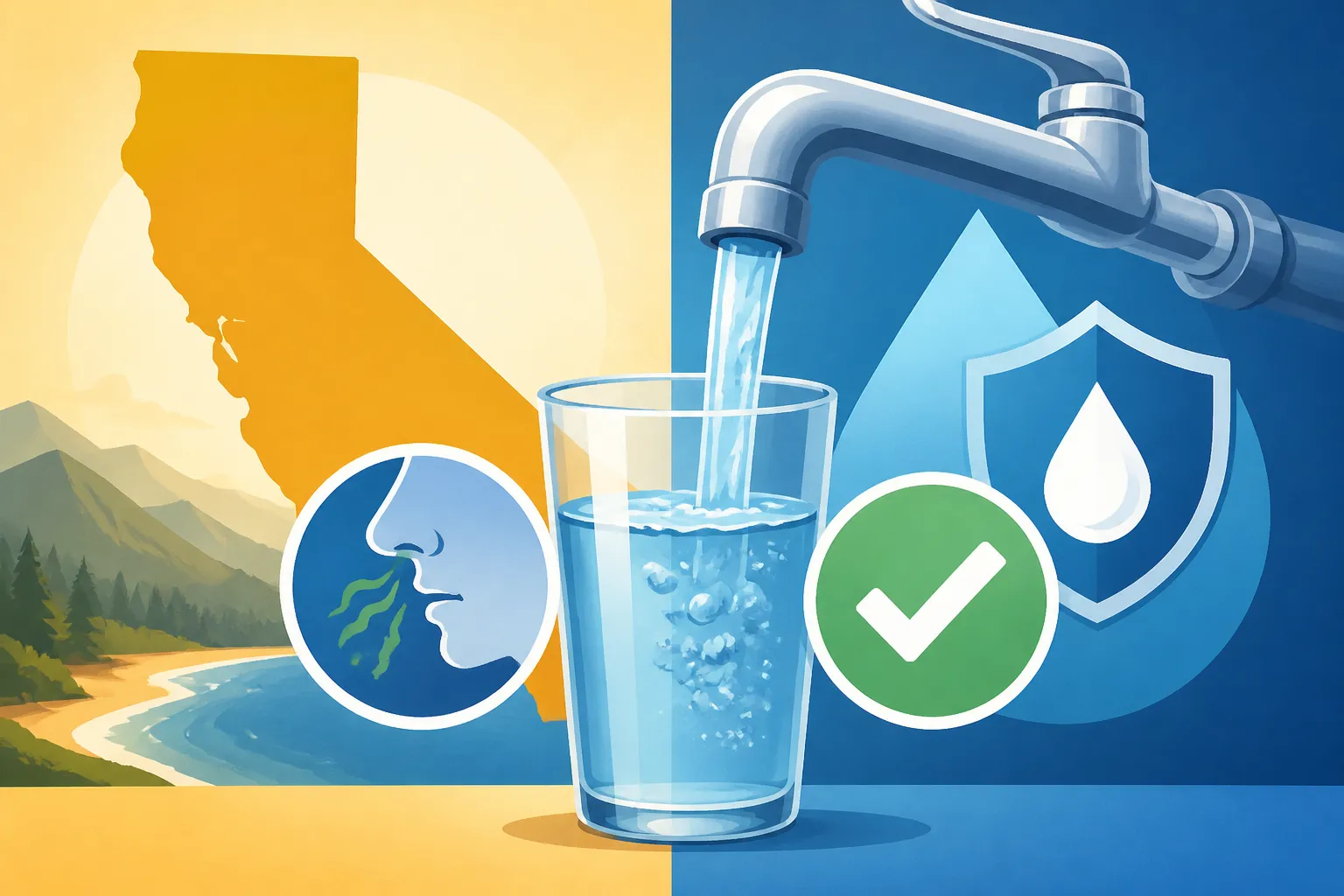
Some changes are mainly noticeable because they affect flavor, smell, or appearance. That does not automatically mean they are harmless, and a strong or unpleasant smell does not automatically mean the water is dangerous. Sensory clues are not a substitute for a water-quality test or a supplier’s assessment.
A useful distinction is between a change that seems local and one that could involve a broader supply. A new odor at one tap, for example, gives you a reason to compare with other taps and ask about household plumbing. A change reported by neighbors gives you a reason to contact the supplier and ask whether there is a known issue or current notice. Neither observation determines the water’s safety; both help direct follow-up.
Pay attention to accompanying information. A supplier may post an alert, issue a notice, or provide an explanation for a temporary change. Check the supplier’s official website for current updates, and look for information for your specific service area rather than assuming that a report about another city applies to your home. A New Taste or Odor in California Tap Water: Nuisance or Safety Issue? is the topic of this page; for notices that require specific actions, see Boil-Water and Other Drinking Water Notices in California.
If an official notice gives instructions, follow the notice rather than trying to infer what to do from the smell or appearance. A filter, bottled water, boiling, or another household measure should not be treated as a substitute for the instructions in a current notice. In particular, boiling is not a universal response to every possible water-quality concern. For a specific notice, read its exact wording and contact the supplier if the affected area or recommended action is unclear.
A change can also be worth reporting even when there is no notice. The California State Water Resources Control Board says water quality should be tested more frequently if people are experiencing a noticeable change in the water odor or appearance. That guidance is a reason to take a persistent or noticeable change seriously and ask the appropriate supplier or regulator how the concern should be evaluated. It does not mean every odor requires the same test or that a particular cause has already been identified.
When you look up a water-quality report, keep its scope in mind. A system report describes monitoring for the water system; it does not necessarily answer what is happening at one faucet today. The sampling location, date, and reported result matter. How to Read a California Annual Water Quality Report explains how to interpret a report, while The Limits of a California Utility Report for Judging Your Own Home addresses why a system-wide result may not settle a question about a specific household tap.
A sensory change and a report result answer different questions. Your observation can identify a change worth investigating. A properly selected sample can provide information about particular substances or characteristics. A system report can show what the supplier reports for its monitoring. None should be treated as a universal replacement for the others.
What to do when the change continues
If a new taste or odor persists, or if the water’s appearance has changed noticeably, make a record of what you observe and contact the water supplier. Use the supplier’s official website to find current contact details, alerts, and service-area information. Describe the location, whether the issue affects hot or cold water, when it began, and whether anyone else nearby has noticed it.
Ask direct questions rather than guessing at a cause. You can ask whether the supplier knows of a recent operational change, maintenance work, or water-quality concern affecting your area; whether there is a current notice; and whether the supplier recommends any follow-up. Ask how to identify whether your address is included if an alert or notice covers only part of a service area.
The California State Water Resources Control Board says that concerns about drinking water or potential local water quality issues should be directed to Division of Drinking Water (DDW) District Offices. It also says to contact a Division of Drinking Water (DDW) District Office to reach a local District Engineer. If the supplier cannot resolve the concern, or you need to raise a potential local water-quality issue, use the official California State Water Resources Control Board website to find current information.
Keep a simple log while the issue is being investigated. Include the date and time you noticed the change, which taps were affected, whether the water was hot or cold, and any changes in appearance. Note when you contacted the supplier and what response or follow-up was recommended. These details can help the supplier or a professional understand the pattern and decide what information is useful.
Avoid trying several treatments before you know what the concern is. Different devices are designed for different purposes, and one type of treatment does not address every possible water-quality issue. If a test is recommended, ask what to test for, which tap to sample, and whether the sample should be collected by a laboratory or another qualified person. A general-purpose test may not answer a specific question.
If you arrange your own testing, match the test to the concern and follow the laboratory’s sampling instructions. A sample taken from the wrong location or handled incorrectly may not answer the question you have. A test kit that changes color can be useful for some screening purposes, but a result may need confirmation through a qualified laboratory. For help deciding whether independent sampling is appropriate, see Testing Your Own Tap in California When the Utility Report Looks Fine and Labs, Kits and Programs for Testing Home Water in California.
Do not assume that a neighbor’s result applies to your home. Nearby properties can differ in plumbing, service connections, or supply conditions. A neighbor’s report can be a useful clue to share with the supplier, but it does not replace an assessment of your own address or tap.
If the water’s appearance has changed as well as its taste or odor, report that specifically. The State Water Resources Control Board’s guidance includes a noticeable change in water odor or appearance as a reason water quality should be tested more frequently. If the water looks discolored or cloudy, describe what you see and whether it clears, persists, or appears only at particular taps. Do not assume that a change in appearance has the same cause as a change in smell.
A manganese notice is one example of why it is important to read a notice rather than diagnose by appearance alone. The California State Water Resources Control Board page lists a community water system manganese notice for concentrations over 0.05 mg/L, but less than or equal to 0.20 mg/L. That notice category does not establish that manganese is causing a particular household’s odor, taste, or appearance change. Check the actual notice and contact the supplier or the appropriate office with questions about what it applies to.
Separate household plumbing from the supplied water
A taste or odor that affects one tap may point you toward that fixture or the plumbing nearby, but it does not prove the source. If several taps are affected, the change may be broader, but that still does not identify whether it comes from the supplier, building plumbing, or another cause. The best approach is to compare carefully and share the pattern with the people who can investigate.
Try to make comparisons consistently. Use cold water from different taps, and note whether the change appears immediately or after the water has been sitting. Compare the same type of water rather than hot at one tap and cold at another. If the issue is only present in hot water, say so when you contact a plumbing professional or the supplier; that detail can help determine what to check next.
If the home has a filter or treatment device, note whether water from treated and untreated taps tastes or smells different. Check whether the device is being maintained according to its instructions, but do not assume that a filter is the cause or the solution. A filter’s effectiveness depends on its design, condition, and the specific substance it is intended to reduce. To evaluate a device against a particular test result, see Does That Filter Handle Your Contaminant? How Californians Can Check.
For a renter, report the issue to the landlord or property manager and keep a copy of the communication. Ask whether maintenance work has occurred and whether other units are affected. If you contact the supplier as well, describe the home’s location and what the property manager has told you. Check your lease and the supplier’s current information for any relevant procedures; do not assume that the owner or supplier has already received your report.
For a homeowner, a qualified plumbing professional may be able to inspect a faucet, water heater, or household piping when the pattern suggests a localized issue. An inspection cannot replace testing when a water-quality concern remains, and a utility test may not assess plumbing inside the home. Utility Problem or Your Own Pipes? Sorting Out a California Issue offers more on separating these possibilities.
When discussing the issue with the supplier, ask whether its information applies to the water entering your property or to a wider system area. If a test is done, ask where the sample came from and what it can establish. A sample from a treatment facility, a neighborhood location, or a kitchen tap may answer different questions. System-Wide Results vs. One Kitchen Faucet: A California Comparison explains why those distinctions matter.
A practical response plan
The aim is not to identify a contaminant by taste or smell. It is to gather useful details, check for current official information, and get the right people involved without making assumptions.
- Record the change. Note when it began, which taps are affected, whether it involves hot or cold water, and any visible change.
- Compare carefully. Check whether the issue is limited to one fixture or appears at several taps. Treat the comparison as a clue, not a safety test.
- Check current notices. Use the water supplier’s official website to look for information that applies to your address or service area.
- Contact the supplier. Describe what you noticed and ask whether there is a known issue, current notice, or recommended follow-up.
- Ask about testing. If the change continues, ask what should be tested, where a sample should be taken, and who should collect or analyze it.
- Contact the state office when appropriate. The California State Water Resources Control Board directs concerns about drinking water or potential local water-quality issues to Division of Drinking Water (DDW) District Offices.
- Get health advice from the right professional. If you are concerned about possible health effects, contact your local health department or a medical professional rather than trying to assess health risk from taste or odor.
If a notice is active, follow its instructions and confirm that it covers your location. If there is no notice, a persistent change can still deserve follow-up. If the issue disappears, keep your notes and report it if it returns or if you remain concerned. A temporary improvement does not establish what caused the change.
People often search for the answer to “Is this just a nuisance?” before they have enough information to decide. A more useful first question is “What changed, where, and when?” Then ask “Who can verify whether there is a water-quality issue?” That approach avoids both extremes: dismissing a noticeable change without checking, or assuming a sensory change proves a specific hazard.
Frequently Asked Questions
Can a bad taste or smell tell me whether tap water is safe?
No. Taste and odor can alert you to a change, but they cannot identify its cause or confirm whether water is safe. Contact the supplier about a persistent change and follow any current notice that applies to your address.
Should I wait for a notice before contacting the water supplier?
No. A noticeable change can be worth reporting even when you have not found a notice. Describe what you observed and ask whether the supplier knows of an issue affecting your area.
What if the change is only at one faucet?
Compare it with other taps and note whether it affects hot or cold water. A change limited to one location may help narrow what to investigate, but it does not prove the cause. Consider notifying the property owner or asking a qualified plumbing professional to assess the fixture or nearby plumbing.
Who can I contact about a potential local water-quality issue in California?
The California State Water Resources Control Board directs concerns about drinking water or potential local water-quality issues to Division of Drinking Water (DDW) District Offices. Use the official State Water Resources Control Board website to find current information.
Sources
- California State Water Resources Control Board — GAMA – Domestic Well Testing | California State Water Resources Control Board (checked November 13, 2026)
- California State Water Resources Control Board — Contact Us | California State Water Resources Control Board (checked November 13, 2026)
- California State Water Resources Control Board — Contact Us | California State Water Resources Control Board (checked November 13, 2026)
- California State Water Resources Control Board — Templates for Public Notification | California State Water Resources Control Board (checked November 13, 2026)
Disclaimer
This article is for general informational purposes only and does not constitute professional advice. Laws, prices and regulations vary by location and change over time. Consult a qualified professional for guidance on your specific situation. California Water Guide is not a government agency or water utility and is not affiliated with any public water system.