Clean Drinking Water in California: Sources, Treatment and Standards
If you want to know whether your California tap water is clean, a statewide answer is not enough: supplies differ by location, and water quality can change between the treatment plant and your faucet. Understanding where water comes from, how utilities treat it, and what a water quality report can tell you helps you ask more useful questions about your own supply.
What Clean Drinking Water Means
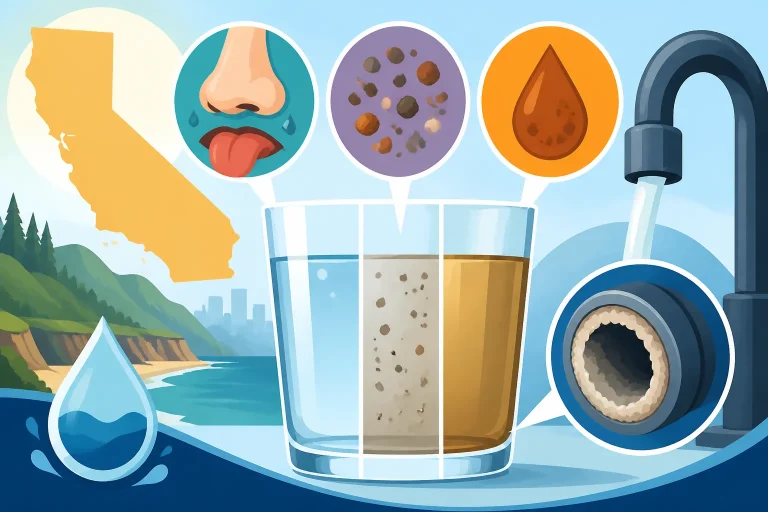
“Clean” can mean water that looks and tastes appealing, water that meets drinking water standards, or water that has been checked for a particular concern. Those meanings overlap, but they are not interchangeable. Clear water is not proof that every contaminant is absent, and an unusual taste does not, on its own, establish that water is unsafe.
For public water systems, drinking water quality is assessed through monitoring and comparison with applicable standards. A report can show which substances were tested, what results were found, and whether a result exceeded an enforceable limit. It does not necessarily tell you everything about water in your home. Results for a system or service area cannot automatically describe the water from one particular faucet, especially where plumbing, fixtures, or household treatment may affect it.
It also helps to distinguish a detection from a violation. A test may detect a substance at a level below an applicable limit. That is different from a result above a limit, and both are different from a health goal that is not itself an enforceable standard. The meaning depends on the substance, the result, the benchmark used, and the context in which the sample was collected. For help with those terms, see Detected, MCL, Violation: Reading the Terms in a California CCR.
In practical terms, judging your water means asking several questions:
- Who supplies water to your address?
- What sources does that supplier use?
- What does the supplier test and report?
- Is there a current notice or local change affecting service?
- Could plumbing or a fixture in your home affect the water at the tap?
- Does a specific concern call for a targeted test or a different source of information?
These questions are more useful than trying to label all California tap water as either safe or unsafe. Water quality is local, and the best evidence for your home begins with identifying your supplier and reviewing the information for that system.
Where California Tap Water Comes From
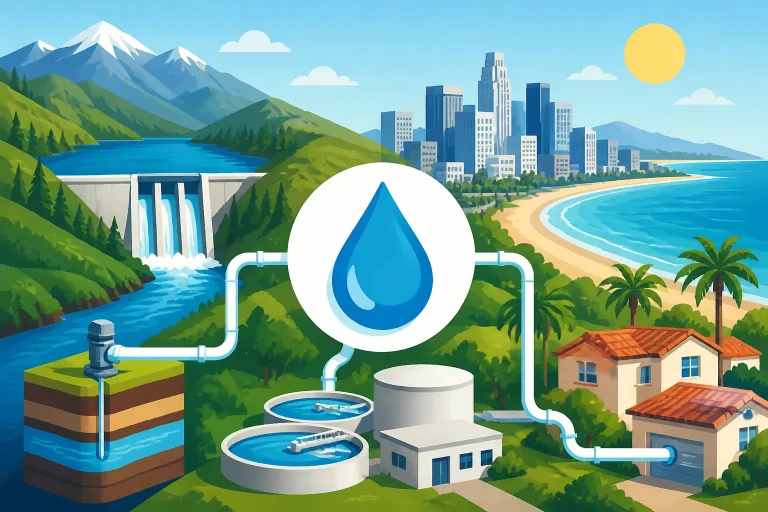
California water suppliers may use groundwater, surface water, imported water, or a blend. The mix depends on the location, the supplier, available supplies, and operating decisions. One neighborhood’s water source may differ from another’s, and a supplier may change the blend over time. To trace the broad pathways, start with Where California’s Tap Water Comes From.
Groundwater and surface water
Groundwater is water held below ground in aquifers. A supplier may pump it from wells, treat it, and send it into the distribution system. Surface water comes from sources such as rivers, lakes, and reservoirs. It may need treatment suited to the source’s characteristics before it enters the distribution system.
Neither source category tells you by itself whether water is clean. Groundwater and surface water can each have naturally occurring substances or contamination concerns. What matters is the quality of the source, the treatment used, how the system is operated, and the results of required monitoring.
Imported water and blended supplies
Some suppliers bring water from outside the immediate area. Imported supplies may travel through a sequence of reservoirs, canals, aqueducts, treatment facilities, and local distribution networks before reaching a home. A utility may also blend water from more than one source. That can mean that the water coming from a tap reflects a combination rather than one single origin.
If a source or blend changes, the water can sometimes taste or smell different even when it continues to meet applicable standards. A change in taste is worth noting, especially if it is sudden, persistent, or accompanied by a utility notice, but it is not a substitute for a test or an official assessment. The supplier can explain which sources serve an address and whether a recent blend change is relevant.
Find the supplier before interpreting a result
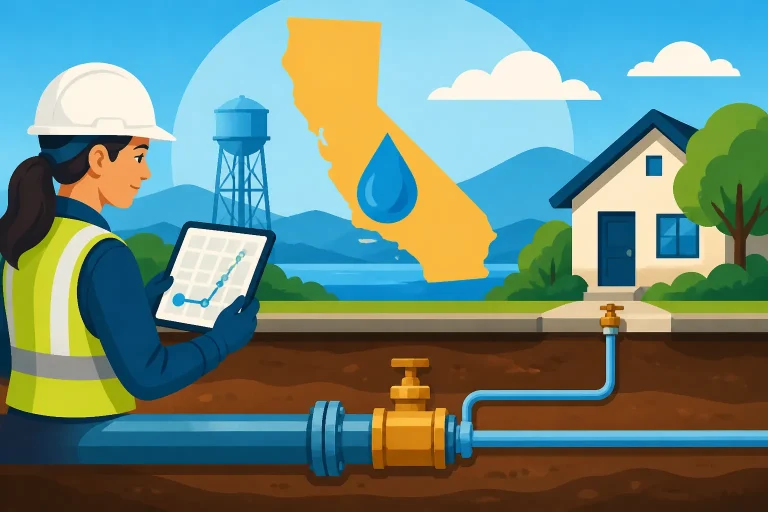
A city name, ZIP code, or county boundary may not be enough to identify the water provider. Service areas do not always match municipal boundaries, and nearby homes may have different suppliers. A renter may not see a water bill and still receive water from a public system, while a rural home may use a private well.
Start with a recent bill, lease information, property records, or the official utility’s service-area information. If you are unsure, Finding Out Who Supplies the Water at Your California Address can help you narrow down what to check. Once you know the provider, use that provider’s information rather than assuming a report for a neighboring city applies to your tap.
For a broader explanation of how a particular area’s water is assembled, see Tracing Your California Home’s Water Back to Its Source and Provider. The key point is that the source is a starting point, not a conclusion about water quality.
How Water Treatment Works
Treatment is designed to address the characteristics and risks of a particular source. There is no single treatment process that all California suppliers use, and no one process removes every possible contaminant. A supplier selects and operates treatment as part of managing its water supply and meeting applicable requirements.
Treatment depends on the source
Water drawn from a river or reservoir may need steps that address particles, microorganisms, or organic material. Groundwater may need treatment for naturally occurring minerals or other substances found in the aquifer. Imported and blended supplies can require treatment that accounts for the source water and the way it is delivered.
Common treatment approaches include filtration, disinfection, and processes that remove or reduce specific substances. The exact arrangement varies. A report may describe treatment in broad categories, but it may not give a household a step-by-step account of every stage at a facility. If a report’s treatment description is unclear, the supplier can explain what it means for the system serving your address.
Disinfection and the distribution system
Disinfection is used to control microorganisms as water is treated and distributed. A disinfectant may remain in the water as it travels through pipes. That residual helps the system maintain protection during distribution, but some people notice a taste or smell associated with treatment.
A disinfectant taste does not automatically mean the water is unsafe. At the same time, a familiar taste is not a quality test. If the odor is new or unusually strong, check for a current utility notice and ask whether the supplier knows of a change in treatment or source blend. For background on this issue, see Chloramines and the Disinfectant Taste in Treated Tap Water.
Treatment has limits
Treatment systems are designed for specific purposes and are monitored as part of the public water system. But “treated” does not mean that every conceivable substance has been removed, nor does a treatment description prove what is happening at a particular household faucet. Some substances may be covered by a supplier’s monitoring and reporting, while others may not appear in a routine report.
Household filters also have limits. A filter designed to reduce one substance may not reduce another, and performance depends on the exact model, installation, maintenance, and water conditions. A product’s marketing language is not enough to establish that it suits your concern. If considering treatment at home, match the device’s certified reduction claim to a relevant water test rather than choosing by taste or a broad “purification” claim. See Does That Filter Handle Your Contaminant? How Californians Can Check before selecting a device.
If water has an unusual appearance, taste, or smell, first determine whether the issue is system-wide or limited to your home. A problem in one faucet may involve plumbing, an aerator, a fixture, or an appliance rather than the supplier’s source water. A sudden change affecting several taps or nearby homes is a reason to contact the supplier and check for alerts. Utility Problem or Your Own Pipes? Sorting Out a California Issue offers a way to think through that distinction.
Standards, Monitoring and Water Quality Reports
Public water standards provide a common way to evaluate results, but reading a report requires more than looking for a contaminant name. The result, units, sampling period, benchmark, and any explanation of a violation all matter. A report is useful evidence about the system; it is not a guarantee about every tap at every moment.
Enforceable limits and health goals
An enforceable standard and a health goal serve different purposes. An enforceable limit is a regulatory benchmark for a public water system. A health goal can provide information about health considerations without operating as the same kind of legal limit. A result above a goal does not automatically mean that the supplier has violated an enforceable standard.
This distinction matters when a report shows a detection or lists a comparison value. Avoid interpreting a result from a single label alone. Check what benchmark the report uses and whether the supplier identifies a violation, required follow-up, or other response. For a closer explanation of the distinction, see Enforceable Limit or Health Goal? Two Benchmarks in a California CCR.
Reports also require attention to units. Two results can look different because they are expressed in different units, and a result may need to be compared with a standard that uses the same unit. If a report lists an unfamiliar abbreviation or value, look for the report’s explanation or ask the supplier rather than trying to compare numbers from unrelated sources.
Monitoring and sampling
Water suppliers collect samples according to monitoring requirements and system procedures. A sample is a measurement from a particular place and time, not a continuous reading from every home. Reports commonly summarize monitoring over a defined reporting period, so the data may not reflect a change that happened after the samples were taken.
Where a sample was collected also matters. A source-water result, a treatment-plant result, a distribution-system result, and a household faucet result answer different questions. A system report may not show whether the kitchen faucet in one older home was tested. For that specific issue, see Does a California CCR Show Whether Your Own Faucet Was Tested?.
If your concern relates to your home’s plumbing, a system-wide report may not settle it. The water can change as it passes through service lines, household pipes, fixtures, or plumbing materials. A targeted sample at the right location may be needed to investigate that question. The Limits of a California Utility Report for Judging Your Own Home explains why a clean system report and a household plumbing concern can coexist.
What a report can and cannot tell you
A water quality report can help you understand:
- Which substances the supplier monitored and reported.
- The results and units shown for those substances.
- The standards or benchmarks the report uses.
- Whether the supplier reports a violation or other required action.
- Some of the sources and treatment processes serving the system.
It may not tell you:
- The exact result at your kitchen faucet.
- Whether your own household plumbing has affected the water.
- Whether a new local condition has developed since sampling.
- Whether a concern that was not included in the report has been tested.
- Which household filter, if any, would suit a specific result.
For a practical walkthrough of report terms and results, see How to Read a California Annual Water Quality Report. If you do not know which report applies to your home, begin with Finding the Consumer Confidence Report for Your California Address. Use the official supplier’s website to find a current report or contact details.
Local Contaminants and Changing Conditions
Contaminants can enter water from different sources, and their relevance depends on local conditions. Some are naturally present in groundwater; others are associated with human activity. A substance’s presence in a region, a nearby property, or another utility’s supply does not establish that it is present in your tap water. Conversely, the absence of a concern from a general description does not prove that it has been tested at your address.
PFAS and potential sources
PFAS is a broad group of substances, and investigations often focus on possible sources as well as water test results. The California State Water Resources Control Board identifies four major sources of PFAS in drinking water as fire training and response sites; industrial sites; landfills; and wastewater treatment plants and biosolids.
These potential sources help explain why testing and monitoring can be location-specific. They do not show that a particular water system or household is affected. To understand what is known about a specific public supply, check the supplier’s reported results and any relevant notices. For a private well, public-system monitoring results from a nearby area are not a substitute for testing that well.
A PFAS result also needs context: the specific substances tested, the sampling location and date, the units, and the benchmark being discussed. A nearby detection cannot be applied automatically to another address, and a general label such as “PFAS found” does not tell you the level in your own water. See PFAS in California Drinking Water: Levels, Orders and Results for more on how to interpret information about these substances.
Naturally occurring substances and local risks
Groundwater can contain naturally occurring substances because of local geology. Agricultural activity, industrial land uses, septic systems, or other conditions can also influence which contaminants may be relevant in an area. This is why the best test panel depends on the water source and the concern being investigated. Ordering a broad or expensive test without a reason may miss the point; ordering only a basic panel may fail to address a known local risk.
For a public system, start with its report and ask the supplier about a particular result or source. For a private well, the owner is responsible for understanding the well’s water quality, so testing needs to be based on the well’s location, construction, and possible risks. A city water report does not describe a private well, even if the well is close to homes served by that system.
Notices and recent changes
A water quality report is not the same as a current alert. If the supplier issues a notice, follow the notice’s instructions rather than relying on an older report or general advice. Notices can give instructions about whether to drink, boil, or avoid using water for certain purposes. The right response depends on the notice itself; boiling, for example, is not a universal solution for every type of water concern.
Use the utility’s official channels to check current notices and service updates. A neighbor’s message or a social media post may alert you to investigate, but confirm the affected area and required actions with the official supplier. Boil-Water and Other Drinking Water Notices in California explains why the wording of a notice matters, and Is Your Address Inside the Affected Area of a California Water Notice? can help with checking whether a notice applies to your location.
How to Check the Water at Your Home
A reliable home check starts by defining the question. Are you trying to identify your supplier, understand a reported result, investigate a taste change, or test for a substance that may come from household plumbing? Each problem calls for a different source of information.
Identify the system and find its report
First, confirm whether your home receives public water or uses a private well. If you have a public supplier, identify the system serving your exact address. Do not assume that a neighboring property or a nearby city uses the same provider. Find the supplier’s current water quality report and any current notices through official utility channels.
Read the report for the period it covers, the substances listed, the results and units, and the explanations of standards or follow-up. If the document shows a detection, do not treat the word alone as proof of a violation. If it shows no reported detection, do not assume that it answers questions about your plumbing or about substances outside the report’s scope.
If you rent, ask the landlord or property manager which supplier serves the building and how water notices reach residents. You can also check the supplier’s official information independently. A tenant may not receive a water bill directly, but still needs to know how to get alerts and the report relevant to the address. See Renters and California Tap Water: Reports, Alerts and Lead Letters for renter-specific considerations.
Work out whether the issue is local to the home
Notice where and when the problem occurs. Does the taste or odor affect hot water, cold water, one faucet, or multiple taps? Did it begin after plumbing work, a period away from home, a utility repair, or a change in supply? These observations are clues, not a diagnosis, but they help the supplier, plumber, or laboratory understand what to investigate.
A problem limited to one fixture may point toward a faucet, aerator, or nearby plumbing. A change at several taps may suggest a wider household or system issue. If the change is sudden, contact the supplier and check for current notices before assuming it is harmless. Do not use appearance or taste alone to determine whether water is safe.
For lead concerns, source-water results do not rule out lead entering water from service lines or household plumbing. A service-line record can be useful, but it may not answer every question about indoor pipes, solder, or fixtures. If lead is the concern, review Lead Pipes and California Tap Water: Inventories, Letters, Removal and Non-Lead Service Line, Lead Indoors? California Plumbing and Fixtures.
Test for a defined concern
Testing is most useful when the test is designed for the question. If a report, local condition, plumbing material, or specific change gives you a reason to investigate, identify the substance or property you want measured and select an appropriate laboratory or testing program. For results that may affect drinking-water decisions, ask whether the laboratory is accredited for the exact analysis you need.
A general home test kit may be useful for screening some properties, but it may not identify a contaminant precisely or provide a result that can be compared confidently with a standard. Sampling instructions matter: the tap, flushing or stagnation conditions, bottle handling, and delivery timing can all affect whether the result answers the intended question. Follow the laboratory’s instructions and ask for help before collecting a sample if the method is unclear.
For a public system, ask the supplier whether it can explain its monitoring or direct you to relevant information. The supplier may not test every household faucet or offer a custom analysis for every resident. If the concern is specific to your home, an independent sample may be necessary. Testing Your Own Tap in California When the Utility Report Looks Fine explains how a household test fits alongside a system report, while Labs, Kits and Programs for Testing Home Water in California covers ways to approach testing.
Decide what to do with the result
A laboratory result is not a treatment recommendation by itself. Check the units, sample location, date, test method, and comparison value. If a result is unexpected or close to a relevant benchmark, ask the laboratory whether the sample or analysis should be confirmed. A retest can be appropriate where sampling error, a changing condition, or a result that does not fit other evidence is a concern.
If the result indicates a problem, the next step depends on the contaminant and source. A public water supplier can explain system-level actions and notices. A local health department or medical professional is the appropriate source for questions about possible health effects. A qualified water professional can help assess household treatment, but any proposed device should match the verified result and have an applicable certification for the claimed reduction.
Do not assume boiling is a universal fix, and do not install a treatment device based only on a sales test or a broad claim. A device designed for one contaminant may not reduce another. Confirm the exact model’s performance claim and maintenance requirements, and retest when needed to check whether treatment is working.
Making a Practical Decision
For many households, the most efficient approach is to move from the broadest question to the most specific one. Confirm the water source, review the current system information, investigate any unusual change, and test only when there is a clear reason and a suitable method.
| Your question | Best starting point | What that information can answer | What it may not answer |
|---|---|---|---|
| Who supplies my water? | A recent bill or the official utility’s service-area information | Which provider’s report and alerts to check | The result at a particular faucet |
| What does the supplier report? | The current water quality report | Reported monitoring, results, and benchmarks | Conditions after the sampling period or inside household plumbing |
| Is there a current warning? | The supplier’s official notice and alert channels | Whether an instruction applies to your service area | Whether an old report reflects the current event |
| Is the issue in my home? | Compare taps and timing; contact the supplier or a qualified professional | Clues about whether the issue may be fixture-, plumbing-, or system-related | A definitive contaminant identification without suitable testing |
| Should I test? | A defined concern and an appropriate laboratory or program | A result for the substance and sample location tested | Other substances that were not included in the analysis |
| Should I buy a filter? | A verified result and the exact device’s certified claim | Whether the device is designed to reduce the concern | Whether it will work properly without correct installation and upkeep |
If your only concern is a familiar disinfectant taste and there is no notice or new change, you may want to ask the supplier whether the source blend or treatment has changed before buying equipment. If a result in a report is unfamiliar, first identify whether it is a detection, an exceedance of a health goal, or a violation of an enforceable limit. If your concern is lead, do not rely only on a general system report; household plumbing and service-line information matter.
If you use a private well, the path differs. A public utility’s treatment and monitoring do not cover your well. Testing and maintenance are the well owner’s responsibility, and the right tests depend on the property and local conditions. A clear appearance and normal taste are not substitutes for laboratory testing. See A Homeowner’s Guide to Annual Checks on a California Domestic Well for well-specific planning.
If you are dealing with a current notice, follow its exact instructions first. If the concern is about health effects, speak with a local health department or medical professional. If it is about a water quality report, ask the supplier to explain the result and the period it covers. If it is about one faucet or a household line, a targeted test or plumbing assessment may be more informative than another system-wide report.
The useful takeaway is not that every household needs a filter or a new test. It is that decisions should match the evidence: identify the supplier, review information for the right service area, distinguish a report from a current notice, and use a properly selected test when a specific question remains.
Frequently Asked Questions
Is California tap water safe to drink?
There is no single answer for every address. Check the current report and notices for the supplier serving your home. If you have a specific concern about plumbing, a private well, or a health effect, use the appropriate test or ask a qualified professional.
Does a water quality report describe the water at my faucet?
Not necessarily. A report summarizes monitoring for a water system, while household plumbing and fixtures can affect water after it enters a home. A targeted faucet sample may be needed to answer a question about your own tap.
Does clear water mean it is clean?
No. Appearance and taste can be useful clues when something changes, but they cannot establish whether all relevant contaminants are absent. Use reports, notices, and appropriate testing to assess a specific concern.
Should I buy a filter if a contaminant is detected?
A detection alone is not enough to choose a device. Check the result, units, benchmark, and sample location, then confirm that the exact device is certified for reduction of the substance at issue. Follow maintenance instructions and consider testing again to check performance.
What should I do when a notice conflicts with older report information?
Follow the current notice’s instructions and confirm that it applies to your address through the supplier’s official channels. An older report describes its own monitoring period and does not replace current instructions.
Sources
- California State Water Resources Control Board — PFAS: Per- and Polyfluoroalkyl Substances Drinking Water Systems | California State Water Resources Control Board (checked November 13, 2026)
Disclaimer
This article is for general informational purposes only and does not constitute professional advice. Laws, prices and regulations vary by location and change over time. Consult a qualified professional for guidance on your specific situation. California Water Guide is not a government agency or water utility and is not affiliated with any public water system.