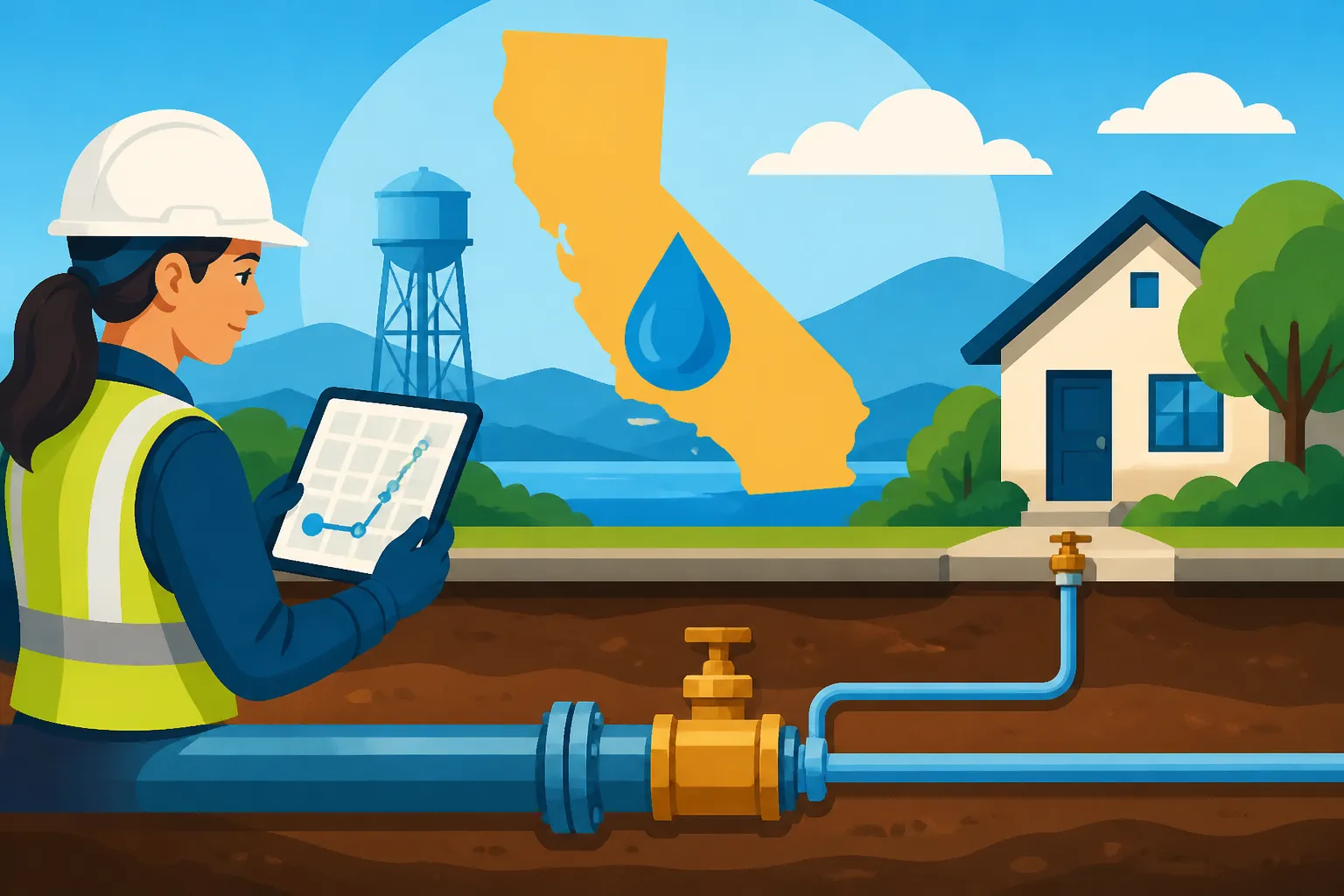
How California Utilities Inventory Their Service Lines
A service-line inventory is a utility’s record of the pipe materials connecting a water main to homes and other buildings. In California, inventories help identify known lead lines and places where material is still uncertain. Knowing what the inventory can—and cannot—tell you makes it easier to check your address, ask useful follow-up questions, and understand what an “unknown” result means.
What a service-line inventory records
A service line is the pipe that carries water between a water main and a building. Depending on the property and local arrangement, the pipe may include a utility-owned section and a customer-owned section. The boundary between them is not necessarily the same everywhere, so it is worth asking the water provider how it defines the service line and which portion its records cover.
A service-line inventory is a record of pipe material, not a guarantee that every part of a property’s plumbing has been inspected. The inventory may describe a line as lead, non-lead, or unknown. These labels answer a specific question about the service line. They do not automatically tell you what materials are inside the building, whether a faucet or fitting contains lead, or what a water sample from your tap would show.
The distinction matters because water travels through more than the service line. Plumbing inside a building and fixtures connected to it can also affect what comes out of a particular tap. A utility inventory and a tap-water test answer different questions: one concerns the recorded material of a pipe connection; the other concerns a sample collected at a particular location and time.
| Inventory label | What it generally tells you | What it does not settle |
|---|---|---|
| Lead | The utility has identified a service-line section or line as lead under its inventory approach | Whether other plumbing inside the building contains lead, or what a specific tap sample would show |
| Non-lead | The recorded line or section is classified as a material other than lead | Whether the building has lead plumbing, fixtures, solder, or other potential sources |
| Unknown | The utility does not have enough information to identify the material confidently | That the pipe is lead, or that it is free of lead |
| Partial or mixed information | The utility’s records distinguish sections or materials rather than giving one simple answer for the whole connection | The material of sections not covered by the available information |
The inventory is useful even when it contains unknowns. It can show where a utility has reliable material information, where additional investigation may be needed, and whether the information applies to the whole service line or only a portion. But a map or address search should be read as a record of what the utility has documented, not as a complete plumbing inspection of the property.
For a broader look at the relationship between utility records and household plumbing, see The Limits of a California Utility Report for Judging Your Own Home. If you are trying to understand a particular classification, Lead, Non-Lead or Unknown: Your California Home’s Service Line Status explains why those labels matter to residents.
How utilities develop an inventory
Utilities need a way to associate service-line materials with specific connections. The information may come from records gathered over time, observations made during work on a line, or other information the utility considers useful. The exact process and the detail available can vary from system to system. A record that looks complete on a public-facing map may still rely on information collected at different times or with different levels of certainty.
A practical inventory process has several parts:
- Identify the lines and addresses to track. The utility needs to connect its service-line records to the properties or accounts they serve. Address information, service records, and maps may help establish that connection.
- Review existing records. Older construction or maintenance records may describe the material of a pipe, but records can be incomplete, inconsistent, or unclear about which section they describe.
- Assess the material information. The utility evaluates whether the available evidence supports a material classification. Where it does not, the line or area may remain unknown.
- Record the result. The inventory may show a material for the line, distinguish sections, or flag unresolved information. A public search tool may present less detail than the underlying utility record.
- Update records when new information becomes available. Work on a line, new documentation, or a resident’s information may give the utility a reason to revisit a classification. Ask the provider how it handles corrections and updates.
Those steps describe the kinds of tasks involved in building and maintaining records; they do not mean every California utility uses the same method or makes every kind of information public in the same way. If you are evaluating a specific address, ask what evidence supports the classification and whether it applies to the full connection.
Why records may be incomplete
An inventory can be difficult to complete when the available information does not clearly identify the pipe material or the extent of the line. Utility records may describe a job without identifying every section, or may not match current address and service-line records. A line might also be difficult to classify from information that does not directly establish its material.
That is why “unknown” should not be translated into either “lead” or “non-lead” without further information. It means the utility has not established a confident classification in its inventory. It is a reason to ask what the provider knows and what steps, if any, it expects to take next—not proof of a particular pipe material.
The State Water Resources Control Board says all community water systems must inventory lead user service lines that are active or expected to become active and identify distribution-system areas with materials that cannot be identified. That requirement makes uncertainty part of the inventory picture: the records are also meant to identify areas where material information cannot yet be established.
A system’s inventory may not tell you what is inside a building, either. The service line ends where the property’s plumbing begins according to the applicable arrangement, and that dividing point may be important when interpreting a result. Ask the utility to clarify its definition, the portion it has records for, and what it means by the label shown for your address. For more on the possible gap between service-line records and interior plumbing, see Non-Lead Service Line, Lead Indoors? California Plumbing and Fixtures.
What a utility can and cannot infer from records
A record showing a non-lead material is helpful, but it is not a statement about every pipe, fitting, or fixture on the property. Likewise, a record showing lead does not identify the condition of the line or establish a tap-water concentration. Those questions require different information.
Avoid assuming that a neighbor’s record applies to your property. Nearby homes may have different service connections, construction histories, or available documentation. Even when a utility’s map groups addresses in a single area, the group may be a recordkeeping or investigation area rather than a claim that every home has the same pipe.
If a utility says its inventory has no lead reported for your address, that wording deserves a follow-up question: does the provider have a confirmed non-lead classification, or does the record simply lack a known lead entry? These are not equivalent. Does No Lead Reported Mean Every California Line Was Dug Up? covers that distinction, while Is the Customer-Owned Pipe Counted in California’s Lead Line Records? can help you ask whether the record includes the customer-owned portion.
California inventory requirements and key dates
California has had state inventory requirements as well as a later initial-inventory deadline applying to a broader group of water systems. It helps to keep those dates separate rather than treating them as one deadline or assuming that an older inventory automatically includes every line and every section.
According to the California State Water Resources Control Board, California community water systems were required to inventory partial or total lead service lines by July 1, 2018. This earlier requirement concerned community water systems and partial or total lead service lines.
The State Water Resources Control Board also says that, after completing the inventory, a community water system had until July 1, 2020, to provide the State Water Resources Control Board with a replacement timeline. That date describes a follow-up requirement tied to the earlier inventory process. It is not the same date as the later initial-inventory submission requirement.
According to the California State Water Resources Control Board, community and non-transient non-community water systems were required to submit initial lead service line inventories by October 16, 2024. This requirement covers both categories of systems named by the Board. A non-transient non-community system is not the same category as a community water system, so residents should not assume that the requirements apply only to systems serving a residential community.
| Requirement described by the State Water Resources Control Board | Who it concerns | Date |
|---|---|---|
| Inventory partial or total lead service lines | California community water systems | July 1, 2018 |
| Provide a replacement timeline after completing the inventory | A community water system | July 1, 2020 |
| Submit an initial lead service line inventory | Community and non-transient non-community water systems | October 16, 2024 |
A submission deadline does not mean that an inventory contains equally detailed or conclusive information for every address. The requirement to submit an inventory and the quality or completeness of the information for an individual line are separate questions. A submitted inventory can include unresolved classifications or identify areas where material cannot be determined.
The timeline also does not establish that a particular line has been replaced, that a replacement is scheduled for a specific property, or that the utility has already confirmed the material of every section. If the inventory includes a replacement timeline or related status, ask the provider what it means for your address and whether the information refers to the whole service line or a portion.
The State Water Resources Control Board says technical assistance for service line inventory development and replacement funding is available to community water systems and nonprofit non-community systems. This assistance is directed to systems, not a substitute for asking the utility about an individual address. Residents should use the official utility website to find current contact details and inventory information.
How to check an address and ask for useful details
If you want to know what a utility’s inventory says about your home, start with the water provider identified on your bill or by the property owner or manager. The utility may offer an address lookup, map, written inventory, or another way to request service-line information. If you do not know who supplies the property, Finding Out Who Supplies the Water at Your California Address can help you sort out the provider question.
When reviewing a result, check whether the record describes the entire service line or only one section. Look for the material label, any note explaining uncertainty, and the date or context of the available information if shown. Do not assume that a map’s color or symbol has a universal meaning: use the utility’s own legend and definitions.
If the public-facing lookup does not explain the result, contact the utility through its official website and ask specific questions. Useful questions include:
- Does the inventory entry apply to the full service line or only a utility-owned or customer-owned section?
- What does the material label mean in this utility’s records?
- What information supports the classification?
- Is any section of the line unknown or unverified?
- How can an address record be corrected if the information appears inaccurate?
- Does the utility expect to investigate or update the record, and how can a resident check for updates?
- If the inventory lists a replacement timeline, what does that timeline mean for this property?
- Is there separate information about the home’s plumbing beyond the service line?
Keep the response with your property records, especially if the information may matter during a home purchase, rental, renovation, or future utility work. If the provider gives an explanation verbally, consider asking for the classification and its scope in writing so you can refer back to the same information later.
A renter can still ask about the service-line record, even if the utility account is in a landlord’s name. The owner or property manager may also have records about prior plumbing work. If you are moving, ask the utility and seller or landlord what they know rather than relying only on a neighborhood map. Moving In? Find a California Home’s Utility, Report and Pipe Material offers a broader checklist for checking water information at a new address.
When the inventory is not enough
An inventory does not replace a property-specific plumbing assessment or a tap-water sample. If your concern is whether lead is present at a faucet, the useful next step depends on what question you are trying to answer and which part of the plumbing is in question. A utility can explain its records, but it may not have inspected the plumbing inside the building.
If you want to investigate a tap rather than a service-line record, see Testing Your Own Tap in California When the Utility Report Looks Fine and Could Older Plumbing Undercut a Clean California Utility Report?. A utility-wide water report describes results for the water system under its reporting program; it does not automatically establish the condition of every home’s plumbing.
A result from one property also should not be generalized to a different address. If a neighbor has a known lead line or a test result that raises concern, it is a useful reason to check your own records, but it does not establish your line’s material or your tap’s result. The utility’s inventory, information from the property owner, and any appropriate testing each answer different parts of the question.
If a utility’s record appears inconsistent—for example, the map shows one classification but a letter or maintenance record gives another—ask the provider to reconcile the information. Include the address and, if available, the wording or document that seems inconsistent. If the provider cannot confirm a material, ask whether it is classified as unknown and whether its records cover the full line. Avoid making a repair or treatment decision based solely on a vague map entry.
What to do with a lead, non-lead, or unknown result
The most useful next step depends on what the inventory actually says. A confirmed lead classification, a non-lead classification, and an unknown classification are not interchangeable, and each has limits.
If the record identifies lead, ask whether it applies to the entire service line or a specific section. Find out whether the utility has a replacement plan or timeline for that address and what portion the plan covers. The inventory is a starting point for a conversation about the line; it does not tell you whether the home’s interior plumbing has been checked.
If the record says non-lead, ask whether that classification covers the full service line and what the utility means by the term. Treat it as information about the line described, not as a blanket statement about the building’s plumbing. If your concern is a faucet or indoor pipe, the service-line inventory alone may not resolve it.
If the record says unknown, ask what information is missing and whether the utility has a way for residents to provide relevant documentation or request a record review. An unknown result is not a diagnosis of the pipe material. It is also not confirmation that there is no lead. The practical goal is to understand the uncertainty, find out whether the record can be improved, and consider whether a separate assessment or test addresses your specific concern.
If the inventory gives no result for your address, ask whether the property is included in the provider’s records and how the utility distinguishes “not listed” from “classified as non-lead.” A blank entry, a missing address, and an explicit non-lead designation can mean different things. Ask the utility to explain the distinction rather than inferring it from the display.
For a home purchase, request both the utility’s current classification and any available documentation about repairs or replacements. Ask whether a replacement involved the full service line or just one portion, and whether the provider updated its inventory afterward. A property file may contain useful records, but it should not be assumed to match the utility’s current inventory without confirmation.
For a rental, direct questions to the utility and property owner or manager as appropriate. The utility may be able to explain its service-line record, while the owner may know about plumbing work inside the building. If there is a specific health concern, ask the local health department or a medical professional rather than relying on an inventory label to answer a medical question.
The central takeaway is simple: use the inventory to learn what the utility has documented about the service line, then ask what parts are covered and what remains uncertain. If your concern is the water at a particular tap, look for information that addresses that tap rather than treating a system record as a household test result.
Frequently Asked Questions
Does an unknown service-line entry mean the pipe is lead?
No. Unknown means the utility has not established the material in its inventory. Ask what information is missing and whether the utility can clarify or update the record.
Does a non-lead service line mean the home has no lead plumbing?
No. The inventory concerns the service line as recorded by the utility. It does not necessarily describe indoor pipes, fittings, or fixtures.
Does a submitted inventory prove every address has been physically checked?
Not by itself. An inventory submission is a record of the information available to the system. Ask the utility what evidence supports your address’s classification and whether it covers the full line.
Who should I contact if I cannot find my address?
Start with the water provider serving the property. Use the provider’s official website to find current contact details, and ask whether the address is missing, listed under another identifier, or recorded with an unknown classification.
Sources
- California State Water Resources Control Board — Lead Service Line FAQ Cust (PDF) (checked November 13, 2026)
- California State Water Resources Control Board — Lead and Copper Rule (LCR) for Drinking Water | California State Water Resources Control Board (checked November 13, 2026)
Disclaimer
This article is for general informational purposes only and does not constitute professional advice. Laws, prices and regulations vary by location and change over time. Consult a qualified professional for guidance on your specific situation. California Water Guide is not a government agency or water utility and is not affiliated with any public water system.