Where Southern California Gets Its Water
Southern California does not have one shared water source. A home may receive a changing blend of local groundwater and imported supplies, delivered through a wholesaler and local water provider. Knowing the path helps explain why nearby communities can have different water sources, reports and local conditions—and shows where to look when you want to identify the supply at your address.
Southern California water comes from a mix of sources
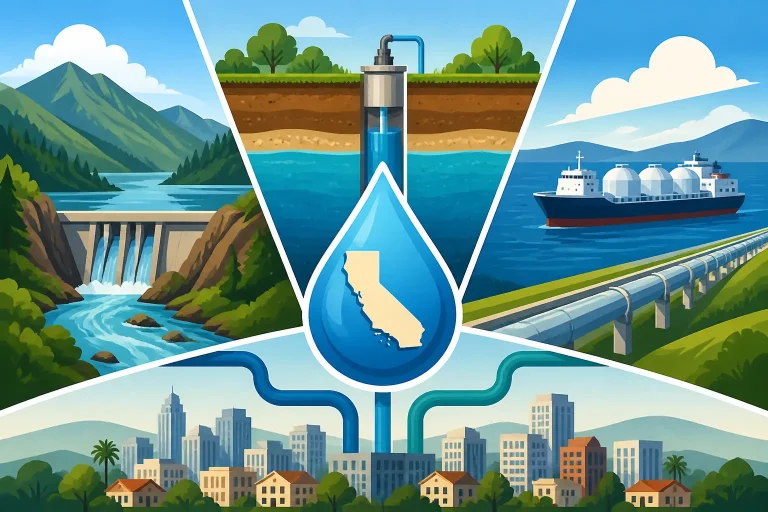
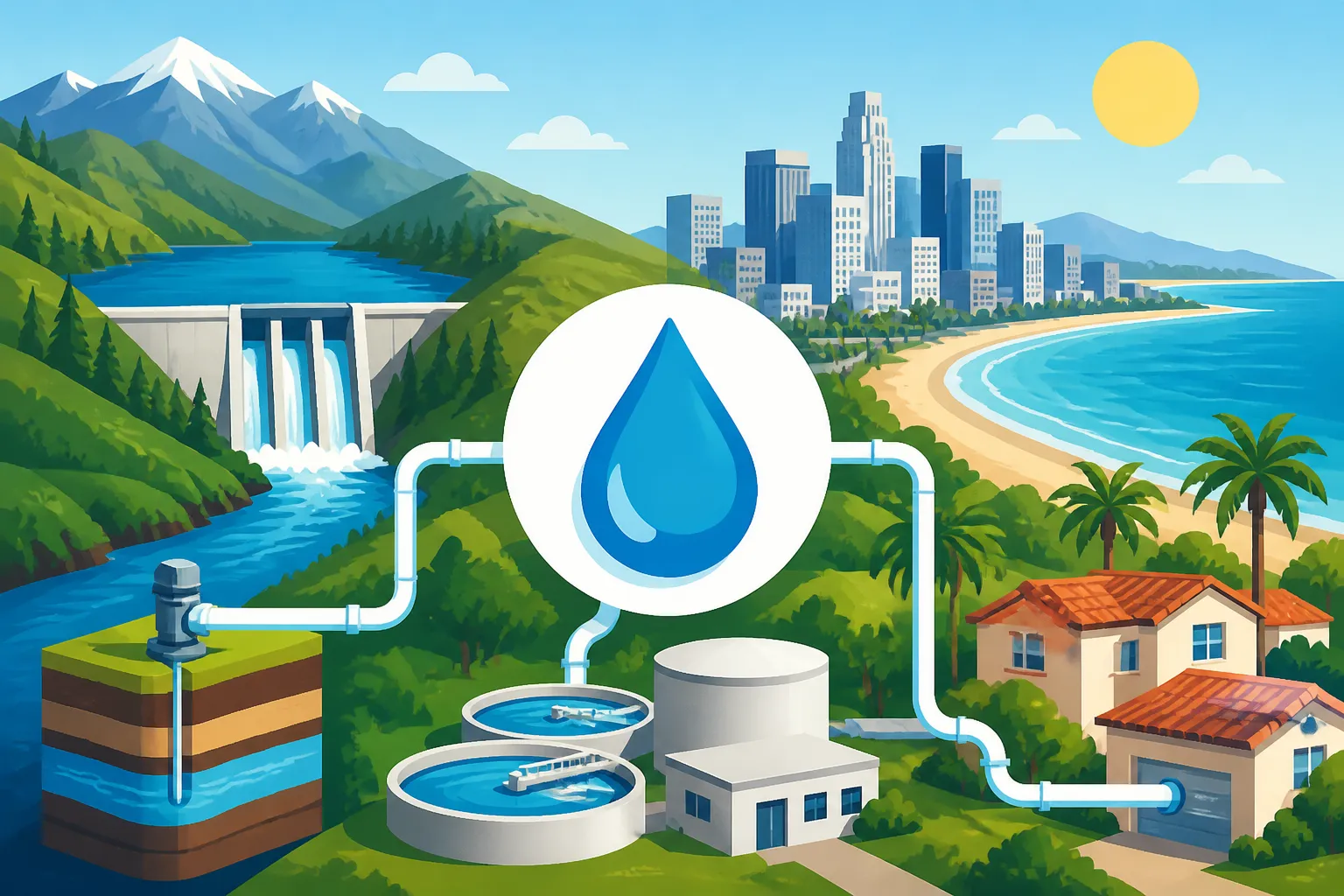
Southern California’s water supply is a connected system, not a single pipe leading from one reservoir to every home. Water can come from local groundwater, local rivers or reservoirs, and imported supplies. Some communities also use recycled water for particular purposes, which can reduce demand on drinking-water supplies without necessarily being delivered to household taps.
The mix depends on where you live, which provider serves your address, what infrastructure is available, and how the provider manages its supply. A water agency may draw on more than one source, and the share from each can change. Drought, maintenance, groundwater conditions, demand and supply agreements can all affect how a system operates.
It also helps to separate the organizations involved. A regional wholesaler can purchase or move water in bulk and sell it to local agencies. A local water provider then delivers water to customers, manages local pipes and facilities, and publishes information about the water it supplies. In some places, a city or district handles these roles directly; elsewhere, a separate wholesaler is part of the chain.
That distinction matters when trying to answer a practical question such as “Where does my tap water come from?” A regional map might show an imported source reaching a wholesaler, but it does not necessarily tell you which supply reaches a particular neighborhood or how it is blended before delivery. A citywide description may also cover a broad service area, while the exact source mix can vary by pressure zone, well, or treatment facility.
For background on the agencies involved, see Where California’s Tap Water Comes From and Who Regulates California Drinking Water? The Agencies and Their Roles. To trace the supply at a specific address, Finding Out Who Supplies the Water at Your California Address is a useful next step.
| Source type | What it means | What to check locally |
|---|---|---|
| Imported water | Water obtained from a source outside the local service area and delivered through regional or wholesale infrastructure | Which wholesaler and imported source serve the local provider |
| Groundwater | Water pumped from underground aquifers through wells | Whether the provider uses local wells, and whether its source mix changes |
| Local surface water | Water collected from rivers, reservoirs or other surface sources in or near the service area | Which sources are treated for the drinking-water system |
| Recycled water | Treated wastewater put to approved uses, often separate from household drinking-water service | Whether it is used locally and for which purposes |
This table describes broad source categories, not the water mix for every community. A provider’s annual water quality report and source information can help connect the regional picture to the water it delivers. If a report uses terms such as “groundwater,” “surface water,” or “imported water” without explaining the route, ask the provider what each term means for your service area. How to Read a California Annual Water Quality Report explains how to read the report itself.
Imported water reaches local agencies through regional systems
Imported water is a key part of the supply picture in many Southern California communities. Two important sources are the Colorado River and the State Water Project. Water from these systems travels through large-scale canals, aqueducts, reservoirs and treatment facilities before it can be delivered to local providers. The precise route and the organizations involved depend on the location.
The Metropolitan Water District of Southern California, commonly called Metropolitan, is a regional wholesaler that supplies water to member agencies. It does not follow that every household in Southern California is served directly by Metropolitan. Often, a local agency purchases or receives water from a wholesaler and then delivers it to customers through its own system. That local provider is generally the right place to ask about the water at your tap.
Imported water can help a community meet demand when local supplies are limited, but reliance on it is not identical everywhere. One provider may have access to local wells or surface water alongside purchased supplies. Another may depend more heavily on regional deliveries. Even a provider that uses imported water may have different sources contributing at different times.
Long Beach provides a concrete example of why source shares should be read as a local, dated snapshot. According to the Long Beach Utilities Department, purchased imported surface water from the Metropolitan Water District of Southern California supplied the remaining 29 percent of Long Beach’s potable water needs in 2025. That figure describes Long Beach’s reported supply for that year; it should not be applied to a neighboring city or treated as a permanent share.
The supply chain can involve several handoffs. Water is sourced, conveyed, treated as needed, sold or delivered to another agency, and then distributed through local infrastructure. A regional wholesaler’s source information helps explain where some of the water originates. The local provider’s report is more directly relevant to what it supplied to customers during the reporting period.
When reading about an imported source, look for the distinction between the source itself and the entity that delivers water to your address. The Colorado River or State Water Project may be part of the origin story, while Metropolitan or another wholesaler may be the organization that supplies a local agency. Your local agency may then blend imported water with groundwater or another supply. These are different parts of the route, not competing answers.
Imported water also has practical trade-offs. It can diversify supply beyond local rainfall and groundwater, but it depends on long-distance conveyance and regional arrangements. Local supplies may reduce dependence on imported deliveries, but their availability depends on local conditions and infrastructure. Providers manage these constraints differently, so a general claim about Southern California cannot substitute for the supply information for your own service area.
For more context on the Colorado River’s role in regional deliveries, see What Delta Water Means for Moving California Water From Its Source and Where Southern California Gets Its Water. To understand a particular local provider’s sources, start with its water quality report and source description rather than assuming that the nearest reservoir or river supplies your home.
Local groundwater and surface water make the mix different from place to place
Local sources can be an important part of the supply, even in communities that also receive imported water. Groundwater comes from underground aquifers and is brought to the surface through wells. Local surface water may be collected from rivers or reservoirs. How much a provider uses from these sources depends on what is available, how its system is built, and how it manages supply.
Groundwater is not a single uniform resource. Aquifers differ by location, and water quality can vary within a region. A provider may operate several wells, rely on some more than others, or adjust pumping based on conditions and operating needs. A city’s general description of groundwater use does not identify every well that may contribute to a particular neighborhood.
The same caution applies to surface water. A nearby lake or river is not automatically a drinking-water source for nearby homes. It must be part of the provider’s supply system, and water intended for drinking has to be managed and treated as required. A map showing a water body near a community is not enough to establish that it supplies the tap.
Recycled water is another part of regional water planning, but it should not be confused with drinking water delivered to a household. Recycled water is treated for approved uses, which can include certain outdoor, industrial or other nonpotable applications. Where it is used, it may free up other water supplies for different purposes. Whether recycled water is present in a community—and what it is used for—needs to be confirmed with the local provider.
A community’s supply can change without any visible change at the faucet. Providers may shift the balance among sources, operate different wells, or use more imported water during a particular period. Water from different sources may be blended before distribution. As a result, the source description in an annual report is best understood as a record of the system’s supply over a reporting period, not a guarantee that every drop at every tap came from the same place.
The differences between nearby communities can be substantial because service boundaries and infrastructure do not necessarily follow city boundaries. A home may be within one city but served by a water district, or a provider’s service area may include several communities and unincorporated areas. Even neighbors can have different providers if a boundary runs between their properties.
When a source description mentions groundwater, imported supplies or a blend, use it as a starting point. Check whether the report identifies the source locations or wholesale supplier, and whether it describes multiple service areas. If the provider operates several zones, ask whether the source mix is the same throughout the service area. Local, Groundwater or Imported? Tracing a California City’s Water and How One California City Ends Up With Different Water by Neighborhood cover why citywide summaries may not answer every address-level question.
For people who rely on a private well rather than a public water provider, the situation is different. A private well is not part of the same public distribution chain, and a utility’s report will not describe that well’s water. The well owner needs to understand the well’s own source and testing needs. A Homeowner’s Guide to Annual Checks on a California Domestic Well provides related information for well households.
How to trace the water supply at your address
The most reliable way to identify your supply is to work from the address outward: first identify the provider, then check the provider’s source information, and finally ask how the regional and local sources connect. A broad regional map is useful background, but it may not identify the agency responsible for your service or the water blend serving your neighborhood.
Start with a recent water bill, move-in paperwork or property records. These may name the local water provider, though a landlord, property manager or city billing office may handle the account. If the provider is not clear, use the address lookup or service-area information provided by the relevant official agency. You can also ask the property owner or manager who supplies the water, particularly if the building does not receive a separate water bill.
Once you know the provider, locate its annual water quality report, also called a Consumer Confidence Report. Look for sections that describe water sources, purchased supplies, treatment and service areas. The report may identify a wholesaler, a groundwater basin, wells, surface-water sources, or multiple sources. Note the reporting period and whether the report covers the entire provider or a specific system.
Then check the provider’s source or supply pages. These may give a clearer explanation of how imported water is purchased and delivered, whether local wells are used, and which facilities serve different areas. If the report and website use broad language, ask the provider a focused question: “Which sources supplied the water for my service area during the report period?” That is more useful than asking only where the city’s water comes from.
A practical sequence is:
- Identify the water provider serving the address.
- Find the provider’s latest annual water quality report and source description.
- Note which sources and wholesale agencies the report names.
- Check whether the information applies to the whole service area or just part of it.
- Ask the provider to clarify the source mix or service zone for the address if the report is not specific.
If you are renting, you may not have the account details or receive the report directly. Ask the landlord or property manager for the name of the water provider and how water-quality notices reach tenants. The utility’s official website can also help you find a report or sign up for available notices. See Getting the Annual Water Report as a California Tenant and Renters and California Tap Water: Reports, Alerts and Lead Letters.
Keep the source question separate from a water-quality question. Knowing that water comes from a particular river, aquifer or regional system does not by itself tell you whether the water at your faucet meets applicable standards. Public water providers monitor their systems and publish results, but a system-wide report may not show conditions at an individual tap or inside a building’s plumbing. If your concern is a particular contaminant, taste, odor or plumbing issue, the next step may be different from tracing the source. The Limits of a California Utility Report for Judging Your Own Home explains that distinction.
A source answer can also be time-specific. If you are comparing reports, check the reporting period and whether the provider describes changes to its supply. A provider may use different sources at different times, and a report that summarizes a year may not describe the exact blend on a particular day. For a current operational question, such as whether a source or facility is being used now, ask the provider rather than relying on an older report.
Camarillo-area service and the importance of checking local claims
Some regional information is helpful but still needs to be checked against the official provider for a particular address. University of California Agriculture and Natural Resources says Camarillo, Oxnard, Moorpark, Port Hueneme, and surrounding unincorporated areas are served by Calleguas Municipal Water District and participate in water-use-efficiency programs administered by the Metropolitan Water District of Southern California; confirm the current service and program details with the official agency or water provider.
That example illustrates two separate questions. The first is who serves a location. The second is which organization administers a conservation or water-use-efficiency program. A regional wholesaler may be involved in a program even when it is not the agency that bills a household or maintains the local distribution pipes.
For your address, verify service with the provider or agency directly. City boundaries, service boundaries and program eligibility are not always the same. A community name in a regional description does not necessarily establish that every property in or near that community has the same water provider or qualifies for the same program.
When checking a local claim, look for the official provider’s service-area information, current customer materials and water quality report. If a regional or educational source says a community is served by a particular district, use that as a lead, then confirm the arrangement with the district or provider. This is especially useful when you are moving, comparing properties, or trying to work out which agency should answer a question about a bill, a notice or water quality.
Conservation programs should also be distinguished from water-source information. A water-efficiency program may offer guidance or incentives to use water more carefully, but its existence does not tell you where the tap water comes from. Conversely, identifying a local source does not tell you which conservation rules or programs apply to your property. For local requirements and current program details, consult the official agency or provider.
Frequently Asked Questions
Does all of Southern California get water from the Colorado River?
No. The Colorado River is an important imported source, but Southern California communities use different combinations of imported water, groundwater and local surface water. Check your local provider’s report to see which sources it uses.
Does the Metropolitan Water District supply every Southern California home directly?
No. Metropolitan is a regional wholesaler. A local agency may receive or purchase water from it and then deliver water to customers. The provider serving your address can explain the arrangement.
Can a nearby river or reservoir be assumed to supply my tap?
No. Proximity does not establish that a water body is part of the drinking-water system. Check the local provider’s source description, or ask the provider which sources serve your area.
Where can I find the source mix for my home?
Identify the provider serving your address, then check its annual water quality report and source information. If the report does not explain whether it covers your area, ask the provider to clarify.
Sources
- Long Beach Utilities Department — Consumer Confidence Report – Long Beach Utilities (checked November 13, 2026)
- University of California Agriculture and Natural Resources (checked November 13, 2026)
Disclaimer
This article is for general informational purposes only and does not constitute professional advice. Laws, prices and regulations vary by location and change over time. Consult a qualified professional for guidance on your specific situation. California Water Guide is not a government agency or water utility and is not affiliated with any public water system.