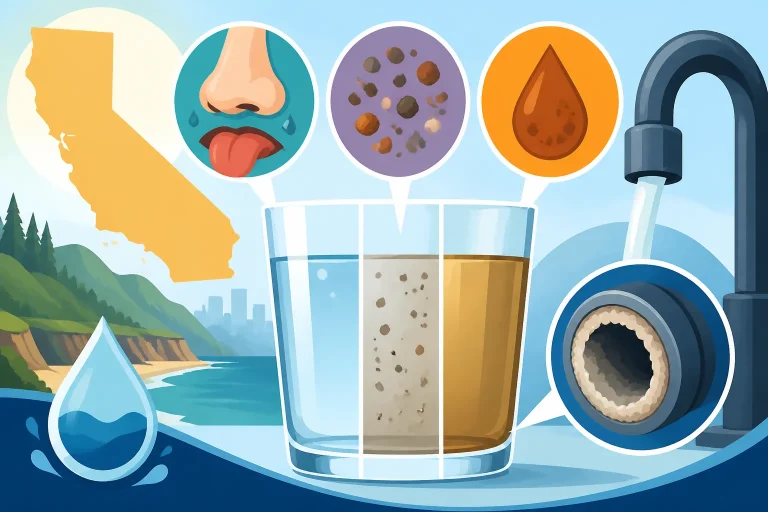
Local, Groundwater or Imported? Tracing a California City’s Water
A city’s tap water can come from nearby wells, distant rivers and reservoirs, or a blend that changes with conditions. That can make it hard to tell where your own water begins. The practical way to trace it is to identify your water provider, check its current supply information, and use its annual report to understand the water quality delivered to customers.
Start With the Provider, Not the City Name
A city name is a useful starting point, but it does not always identify the water supplier or explain where the water comes from. Service areas can cross city boundaries, and a single city can have more than one water provider. Even homes on the same street may have different providers if the service area changes nearby.
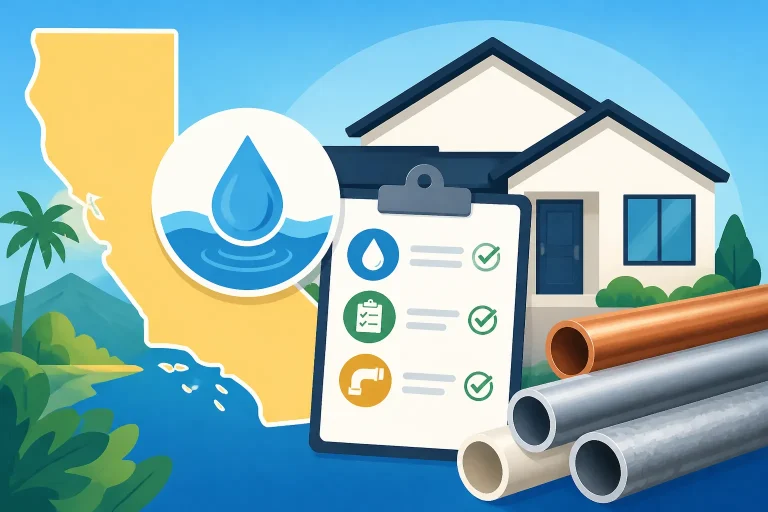
Start by identifying the supplier for your specific address. Check a recent water bill, account notice, or official city or water-provider website. If you rent and do not receive the bill, ask the property owner or manager which provider serves the building. A renter can also look for the utility name on service notices or ask the local water provider to confirm service by address.
Once you know the supplier, look for its water sources or water supply information. The supplier may explain whether its water comes from groundwater, surface water, imported supplies, or a combination. It may also describe the treatment process and any changes in the mix over time.
This first step matters because a city can have more than one source. A provider may operate local wells while also buying or receiving imported water. It may blend sources before the water reaches customers, or use different sources in separate parts of its service area. A general description of the city’s water supply may not tell you which sources serve your home.
If you are new to the area, Moving to California: Setting Expectations for the Water at Your Tap can help you understand why the supply may differ from what you were used to elsewhere. For a direct starting point, Finding Out Who Supplies the Water at Your California Address focuses on identifying the provider for a particular home.
Keep the provider and the source as separate pieces of information. The provider is the organization responsible for delivering water to your home. The source is where that water originates. The organization that manages a source or moves water may not be the same organization that bills you or maintains local pipes.
A simple record can prevent confusion later. Write down the provider’s name, the address it serves, and the official page or report that describes its sources. If a notice, taste change, or construction project prompts questions later, you will know which supplier to contact and which supply information to compare.
What Local, Groundwater, and Imported Water Mean
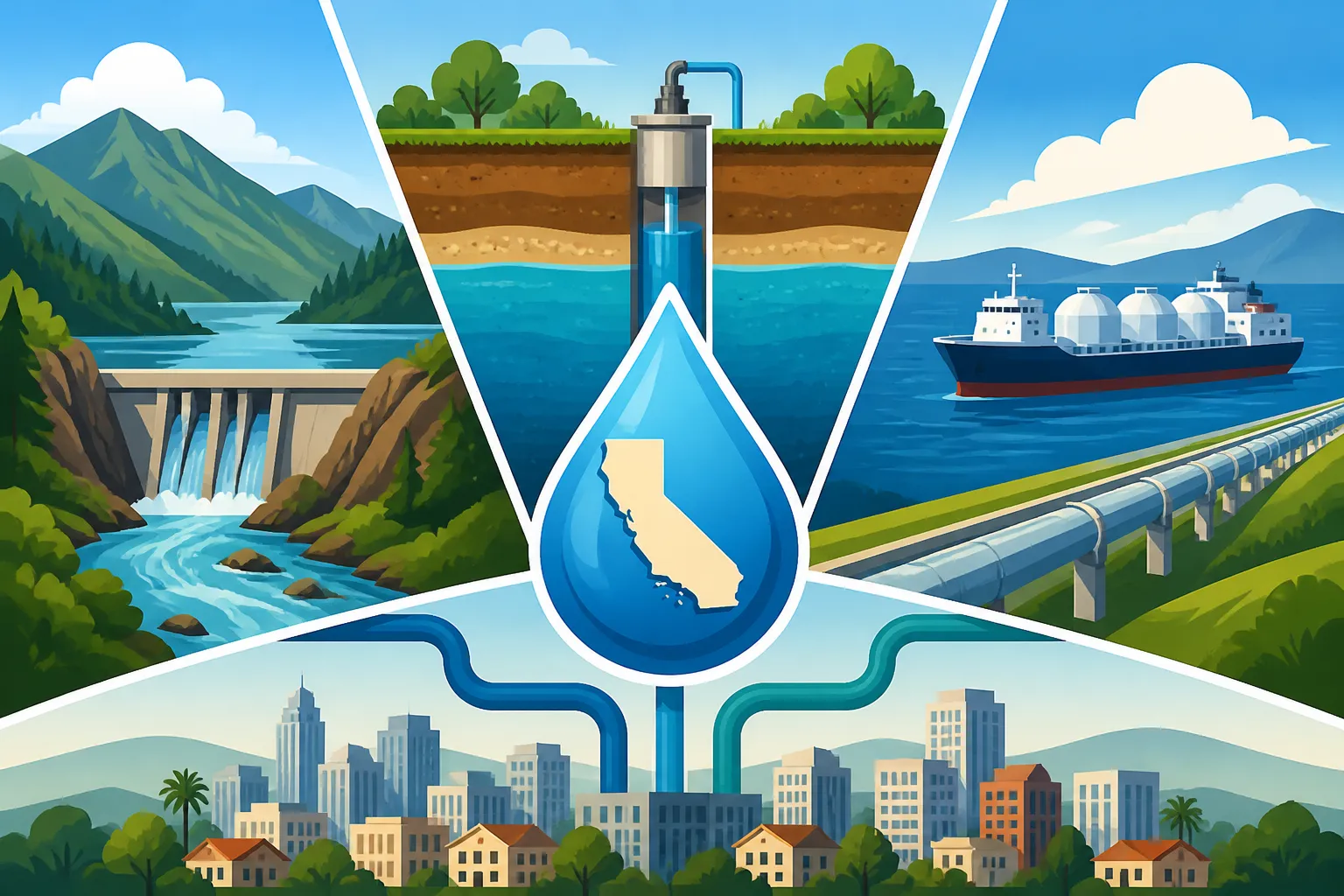
The words used to describe a water supply can sound more precise than they are. “Local” usually describes where a source is in relation to a provider or community, not a particular treatment method or quality level. “Groundwater” describes water stored below the ground and drawn from wells. “Imported” describes water that comes from outside the local area and is conveyed to the service area.
These descriptions tell you about origin, but not necessarily about the water at your faucet. Water from different sources can be treated before distribution, and the source mix can be blended. To understand what reaches your home, combine source information with the provider’s treatment and water-quality information.
Local sources
A provider may draw water from wells or surface-water sources in or near its service area. Local supplies can help a community rely less on water transported from elsewhere, but “local” does not tell you whether the source is a well, reservoir, river, or another supply. Look for the provider’s source description rather than assuming that local water means a particular type of source.
A city can also use several local sources. For example, some parts of a service area may rely more heavily on wells while other parts receive a blend that includes surface water. Ask the provider whether its source information applies throughout the service area or whether the mix differs by neighborhood.
Groundwater
Groundwater is water beneath the land surface, held in spaces in soil and rock. Providers can pump it from wells, treat it as needed, and send it into distribution systems. Groundwater is not automatically untreated, and its mineral content or other characteristics can vary with local conditions.
The California State Water Resources Control Board states that 85% of Californians depend on groundwater for all or part of their water needs. That figure describes dependence across the state, not the source of water at a particular address. To find out whether a specific provider uses groundwater, check the supplier’s source information and annual report.
A provider may use groundwater alone or combine it with other sources. It may also change how much it pumps in response to supply conditions, maintenance, or operational needs. If you are trying to understand a change in taste or mineral deposits, source information can provide context, but it does not establish the cause. Common Causes of Taste, Scale and Staining in California Tap Water can help you distinguish common household nuisances from questions that call for more investigation.
Imported water
Imported water is conveyed from a source beyond the local service area. In California, large water projects and regional arrangements can move water over long distances, after which local providers may treat, blend, and distribute it. A provider’s description of imported water may identify a project or regional supplier, but it may not explain which combination serves a particular neighborhood.
The Department of Water Resources manages water usage and delivers water to two-thirds of California’s population through the State Water Project, according to the California State Water Resources Control Board. This statewide role helps explain how water can travel from its source to communities far away. It does not mean every Californian receives State Water Project water, or that every home connected to a participating provider gets the same blend.
Imported water also does not mean a household’s water is delivered directly from a distant reservoir without local handling. The provider may receive water from another agency, treat or blend it, and move it through its own facilities and pipes. To understand the chain for your home, check both the regional supply information and the local provider’s description.
| Term | What it tells you | What it does not tell you by itself |
|---|---|---|
| Local water | A source is in or near the provider’s service area | The source type, treatment, or exact neighborhood supply |
| Groundwater | Water is drawn from an underground source, often through wells | Whether it is the provider’s only source or what is in a particular faucet sample |
| Imported water | Water comes from beyond the local area | Which project supplies a specific home or how the provider treats and blends it |
| Blended supply | A provider uses water from multiple sources | The precise mix reaching a given address at a particular time |
The table is a starting point, not a substitute for supplier information. A provider may use different terms or explain its sources in separate documents. If the description is unclear, ask whether the source list applies to the entire service area and whether the mix changes seasonally or operationally.
Follow the Water From Regional Supply to Your Tap
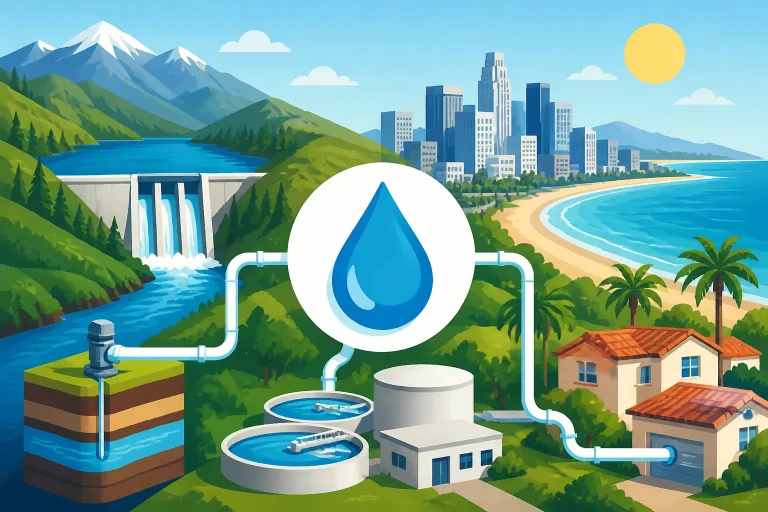
Tracing water is easier when you picture the journey as a chain rather than a single source. Water may begin in a well, river, reservoir, or regional project. It may pass through treatment facilities and storage, enter a local distribution system, and travel through service lines and household plumbing before it comes out of a faucet.
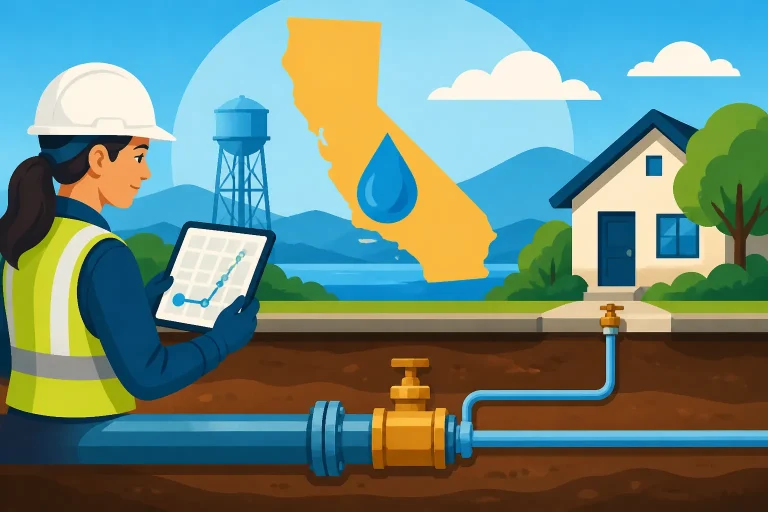
The organization responsible for each link may differ. A regional agency may manage or convey water. A local water provider may purchase that supply, operate treatment facilities, and maintain distribution pipes. The home’s owner or landlord may be responsible for plumbing on the customer side of the connection, depending on the property and local arrangements.
For a useful trace, look for information in this order:
- Identify the supplier for the address. Use a bill, provider account information, or the provider’s official website. If a landlord handles the account, ask for the supplier’s name and the relevant service notices.
- Find the supplier’s source description. Look for groundwater, surface water, imported water, or a blend. Check whether the information covers the full service area or describes only a general system supply.
- Check how the provider handles the water. Look for treatment and distribution information. A source description is not a substitute for understanding what happens before water reaches the local network.
- Read the annual water quality report. The California State Water Resources Control Board advises customers seeking drinking water quality information to refer to their water systems’ annual CCRs. Use the report for the provider’s reported water-quality information, not as a map of the exact water in your home’s pipes.
- Ask about neighborhood differences. If the provider has multiple wells, treatment facilities, pressure zones, or supply sources, ask whether those differences affect your address.
- Keep the report and supplier contact details. Having the documents together makes it easier to compare information if the supply, taste, or service changes.
For more on locating and interpreting the report, see How to Read a California Annual Water Quality Report and Finding the Consumer Confidence Report for Your California Address. If you cannot find a current report, No Annual Water Report in the Mail? Where to Find or Request One covers ways to track it down.
A report is most useful when you know which provider it covers and what service area it describes. If a property receives water from a small provider, a shared system, or an arrangement involving another supplier, ask which report applies to your address. Do not assume a nearby city’s report covers your home just because the city is close by.
Also keep in mind that a system-wide report describes results collected and reported for the water system under its monitoring program. It does not necessarily represent a sample from your kitchen faucet. The water can pass through building plumbing after leaving the provider’s network. If you have a specific concern about your own tap, The Limits of a California Utility Report for Judging Your Own Home explains why a system report and a household sample answer different questions.
What to Ask When the Source Description Is Unclear
A source page may list several supplies without saying how they relate to your address. That does not automatically mean the information is incomplete or inaccurate; it may be written to describe the provider’s overall operations rather than a particular block. A focused question can help you get a useful answer.
Ask the provider:
- Does this source list apply to my address or to the entire service area?
- Does my neighborhood receive water from a particular well, treatment facility, or distribution zone?
- Is the supply a blend, and can the blend change?
- Does the provider receive water from another agency or regional project?
- Where can I find the current annual water quality report for my service area?
- Who should I contact if the issue appears to be inside the building rather than in the public system?
Use the provider’s official website to find current contact details. If the property owner or building manager handles the water account, ask them to identify the provider and share relevant notices. A renter may not be able to see the full utility account, but can still ask which supplier serves the building and where its public report is available.
It helps to describe the question precisely. “Where does my water come from?” can invite a broad explanation. “Does the listed groundwater source serve this address, and is the water blended with imported supply?” makes clear what you want to verify. If the provider cannot identify the neighborhood’s exact source mix, ask whether it can confirm the general supply sources used across its system.
If the question began with a sudden taste, odor, discoloration, or service interruption, describe when it began and whether it affects cold water, hot water, or multiple taps. A source change is only one possible explanation. Plumbing work, a water-main repair, building plumbing, or a notice may also matter. The article Utility Problem or Your Own Pipes? Sorting Out a California Issue can help you organize what to check without assuming the cause.
Do not use source information alone to decide whether water is safe to drink. Source type is not a safety verdict, and a general statewide statistic cannot answer what is happening at an individual home. Use the provider’s current notices and annual report for system information. For a household-specific concern, learn what kind of test would answer the question and who can collect or analyze the sample. Testing Your Own Tap in California When the Utility Report Looks Fine explains when a household sample may add useful information.
If the provider confirms a source or treatment change, ask what changed, when it took effect, and whether the information applies to your address. The response may explain a new taste or mineral pattern, but it should not replace the provider’s water-quality information or an appropriate household test. Keep a copy of the answer with the relevant report so you can refer back to it.
Use Source Information Without Overreading It
Source information is valuable for context, but it has limits. Knowing that a provider uses groundwater does not identify what is in a particular faucet sample. Knowing that a system uses imported water does not mean the water was delivered untreated. A blend can also change, and the provider may describe its supply at a system-wide level rather than for an individual street.
The best way to use source information is to connect it to the question you are trying to answer.
If you are curious about regional supply, look for the provider’s source description and any information it gives about regional agencies or water projects. If you want to know about reported drinking water quality, use the annual report for the correct supplier. If you are responding to a current problem or notice, follow that notice and confirm that it applies to your address. If your concern is specific to one tap or building, consider whether household plumbing or a targeted sample is relevant.
Avoid treating “local” as a guarantee of a particular taste or quality. Local sources vary, and water can be treated and blended. Avoid treating “imported” as a sign of poor quality or extra treatment. Origin alone does not establish the water’s quality. And do not treat a statewide figure as an answer about a particular home: the California State Water Resources Control Board’s 85% figure describes Californians’ dependence on groundwater for all or part of their needs.
If you find multiple reports or provider pages, check the supplier name and service area before comparing them. A report for a neighboring city may be informative about the region but may not describe your water system. Likewise, a regional agency’s supply information may explain where a provider gets some of its water without replacing the local provider’s report.
When the available information leaves a gap, record what you know and ask a specific follow-up question. Keep the address, supplier name, report, and any relevant notice together. That makes it easier to avoid mixing up a regional source with a local provider or a system-wide result with a household sample.
Frequently Asked Questions
Does a California city use only one water source?
Not necessarily. A provider may use groundwater, surface water, imported water, or a blend. Check the provider’s source information and ask whether it applies to your address or to the system as a whole.
Does groundwater mean the water is untreated?
No. Source type does not tell you whether treatment occurs. Check the provider’s description of its treatment and consult the annual report for water-quality information.
Does imported water mean my home receives water directly from a distant source?
No. A regional or external supply may pass through additional providers, treatment, storage, and local distribution before reaching a home. Ask your supplier how the regional supply connects to its system.
Which report should I use to understand drinking water quality?
Use the annual CCR for the water system that serves your address. If you are unsure which system that is, confirm the provider with the utility or property manager before relying on a report.
Sources
- California State Water Resources Control Board — Home Page | California State Water Resources Control Board (checked November 13, 2026)
- California State Water Resources Control Board — Home Page | California State Water Resources Control Board (checked November 13, 2026)
- California State Water Resources Control Board — About Us | California State Water Resources Control Board (checked November 13, 2026)
- California State Water Resources Control Board — Consumer Confidence Reports (CCRs) | California State Water Resources Control Board (checked November 13, 2026)
Disclaimer
This article is for general informational purposes only and does not constitute professional advice. Laws, prices and regulations vary by location and change over time. Consult a qualified professional for guidance on your specific situation. California Water Guide is not a government agency or water utility and is not affiliated with any public water system.